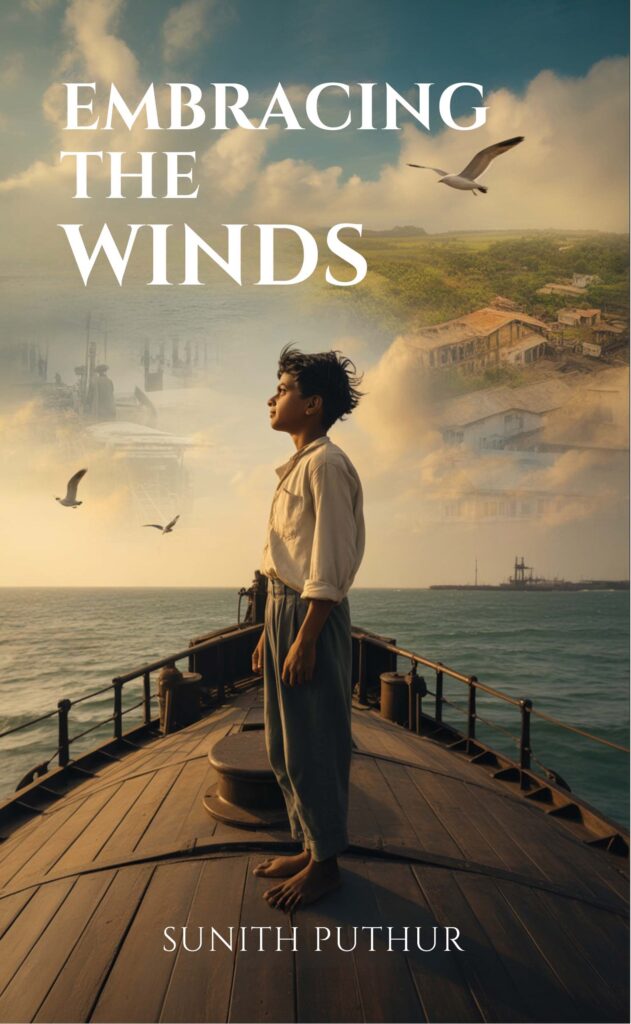
Embracing The Winds
Embracing the Winds, the first part of a historical novel set against the backdrop of the First World War, follows the personal journey of a young Indian boy, Kesu, as he navigates a world of colonial upheaval, war, and human aspiration. Written in a lyrical stream-of-consciousness style, the novel captures the inner life of its protagonist as he moves from the familiar confines of his ancestral home into the wider world.
Kesu hails from the remote rustic hamlet of Ramasila in Palakkad, in the old Madras Province, where he experiences the fragility and turbulence of family life. His mother’s death from smallpox leaves the household fractured, and his sister’s education is abruptly curtailed to suit a prearranged marriage, intensifying Kesu’s restlessness.
When he is suspended from college for supporting a freedom fighter, he sets out from his ancestral home, Puturmadam, seeking a life beyond the limitations of his village. In his exploration he was assisted by many people- Muthu Rowther, the entrepreneur-visionary, Cyrus Irani, the pioneering Parsi superintendent in the work shop of Muthu Rowter who turned a worn-out imported Albion truck into a premium bus, linking Palakkad and the hill station of Ooty, and Jahanara, the refined daughter of Cyrus, who introduces Kesu to the wisdom and poetry of Saadi Shiraz’s Gulistan (The Rose Garden), nurturing in him compassion, human dignity, and resilience.
His journey takes him through the cross-section of early twentieth-century India: a cart ride to the Olavakkode railway station, and a train journey to Madras port. On the way he encounters merchants, racists, and officials from among the passengers.